Interest in the circular economy has been a continuous thread in my work which led to founding my own companies and has resulted in on going research into opportunities across design and manufacture, material and product specifications, supply chain supply and product lifecycles to achieve greater circularity in our built environment.
Each project I work on has circular design principles baked in to the design process with an emphasis on creating opportunities for a positive impact across materials, community and lifecycle.
Decisions that are made at the outset of a product lifecycle or a buildings fit out heavily influence how it can be maintained, repaired, refurbished and ultimately dismantled at end of life.
My approach to embedding whole lifecycle sustainability is that as designers we have the ability to influence longevity through our design and materials specifications.
Rooted in my experience as co-founder of British furniture company MARK Product in 2008. With co-founder John Miller, we set out to address this by building transparency into both design and manufacturing.
Consideration is given to repair and renewal over an assumed 30-year lifecycle, consideration of how components can be accessed, replaced and refinished. And ultimately how can a product be dismantled, separating material components for recycling and establishing whether localised recycling processes were available for our chosen materials.
MATERIALS MATRIX
An ongoing research project into materials. Exploring material lifecycles, manufacturing impact and end of life realities; looking beyond data to establish an informed view.
A key component in any product or building lifecycle impact is our material choices. I have a specification process which built on the principles of prioritising natural, biogenic and regenerative materials, followed by recycled, single-source materials where an established and accessible closed-loop recycling system existed.
Through a Materials Matrix I continually review materials and developments in the recycling of existing products. I question the assumption that a recycled or recyclable material is automatically the sustainable choice, considering it’s origin, shipping and where a material sits within the recycling hierarchy as well as what would happen to it at the end of its useful life.
I also work to a blacklist of materials to avoid including single-use plastics, materials that emit Volatile Organic Compounds and chromium plating.
Read More
Project 75 is an ongoing research project into the attitudes and realities of reusing materials and furniture within design projects. Its ambition is to open up conversations about circularity and to engage designers, specifiers and end users in the opportunities we have to work with what already exists.
In principle, we have the components to make this successful. Reuse of furniture is increasing year on year, yet we’ve not made it a seamless and easy process. There are challenges.
In collaboration with Dominick Pegram of FACT, we have been questioning what those challenges are. How do attitudes and approaches to reuse vary across workplace and hospitality projects?
One output of this work is our concept of a time machine, created by FACT for London Design Festival 2026 this imagination project invites participants to immerse themselves in a time travel journey to 2036.
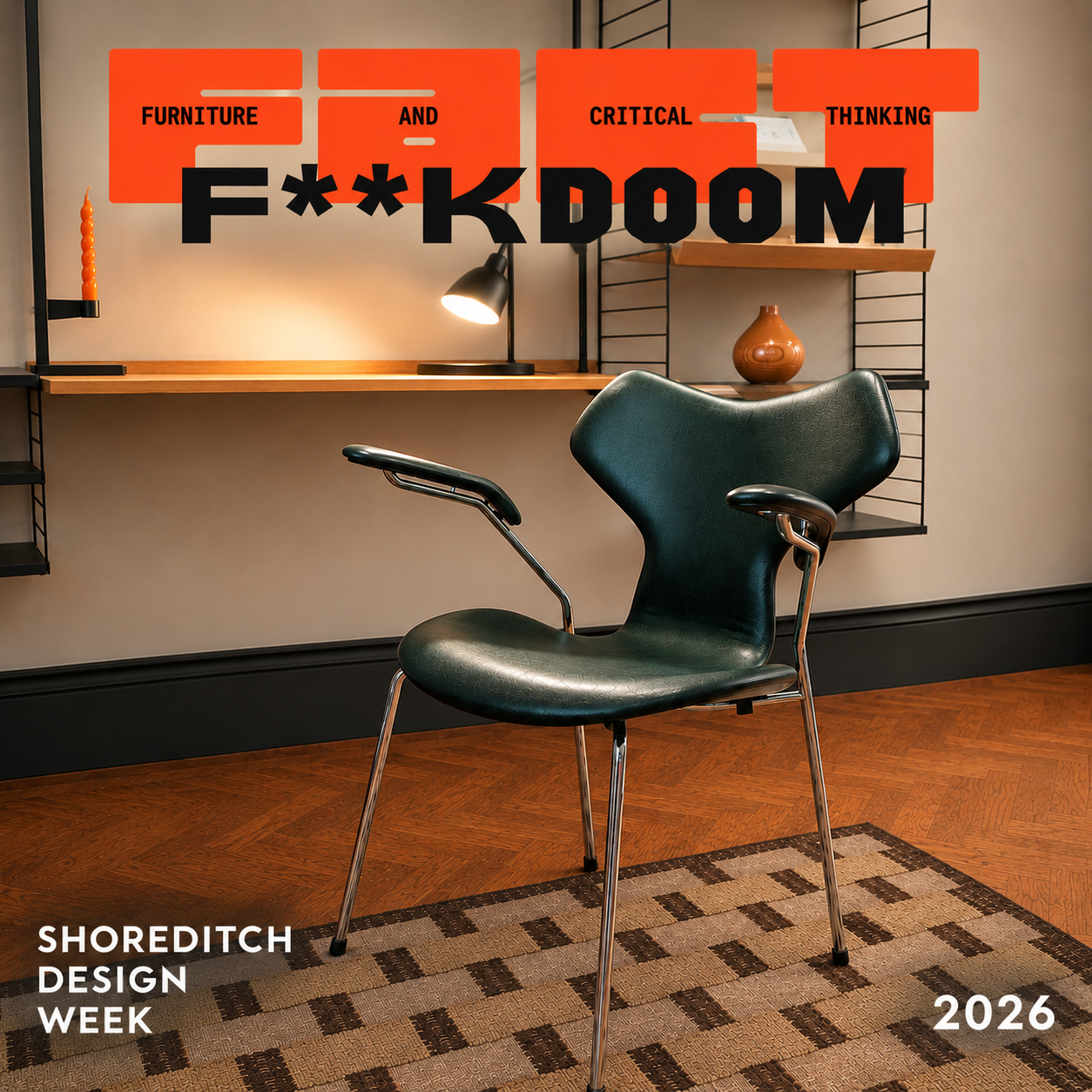
Visitors stepped into a narrative-driven pop-up set in a future where hope won out against doom and we achieved circular design across the built environment. They explored how we got there and questioned the steps it took.
Looking at our own practice as designers through this lens proved a hugely powerful tool. Visitor feedback showed that ambitious reuse targets feel achievable when we use our imaginations to play with the idea of future success, and how we won the battle for circularity and reuse.

Community is deliberately positioned in my sustainable design principles.
We want our outcomes to have a positive impact on the community that uses a product or place but also one that helps to create it.
I believe that we can make a positive impact through responsible specification; valuing more than the environmental impact of a product; looking at who makes it, under what conditions, where value is created and what impact production has on the communities connected to it.
I have developed long-standing relationships with a manufacturing network that enables me to source with transparency and confidence in how a product is produced.